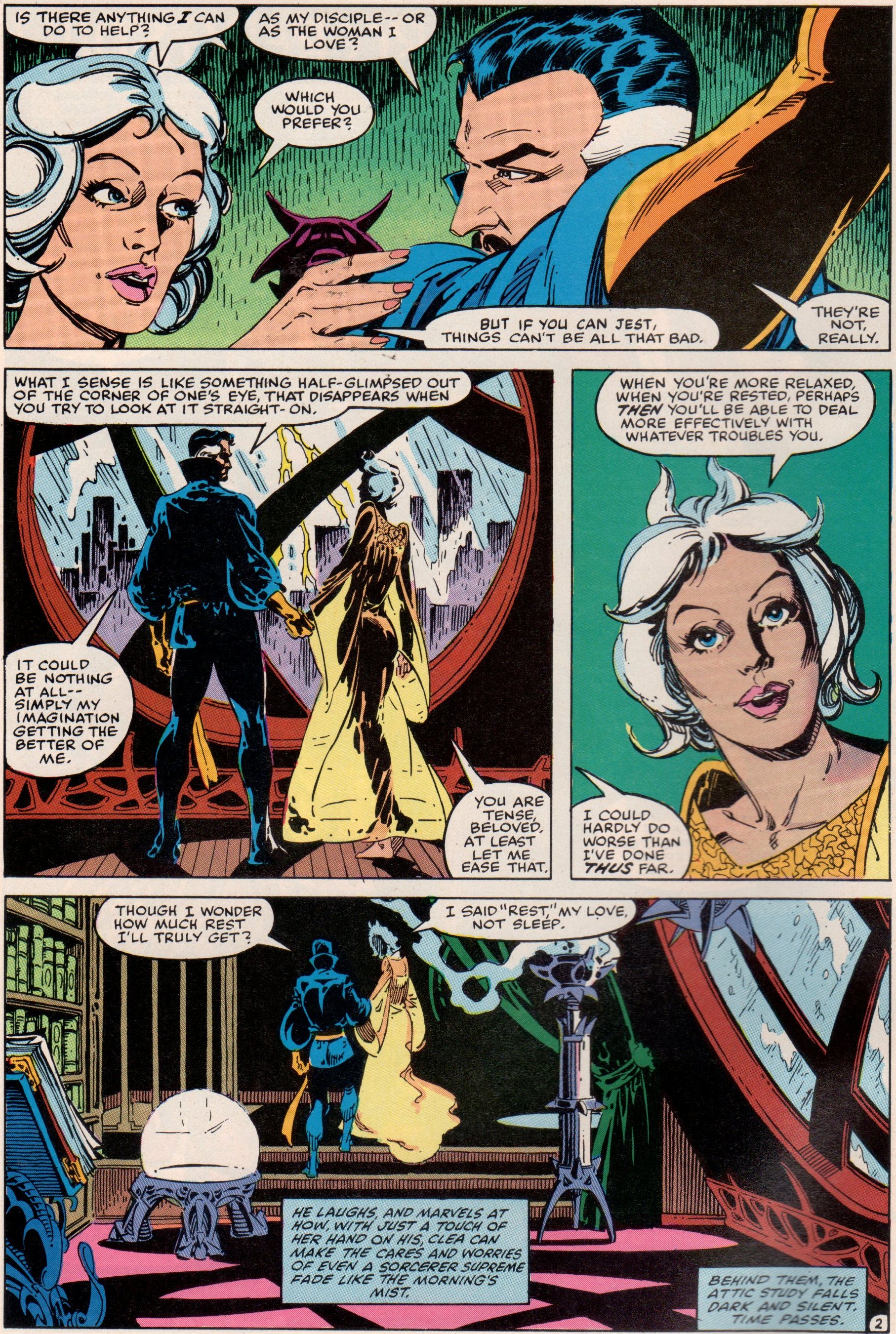
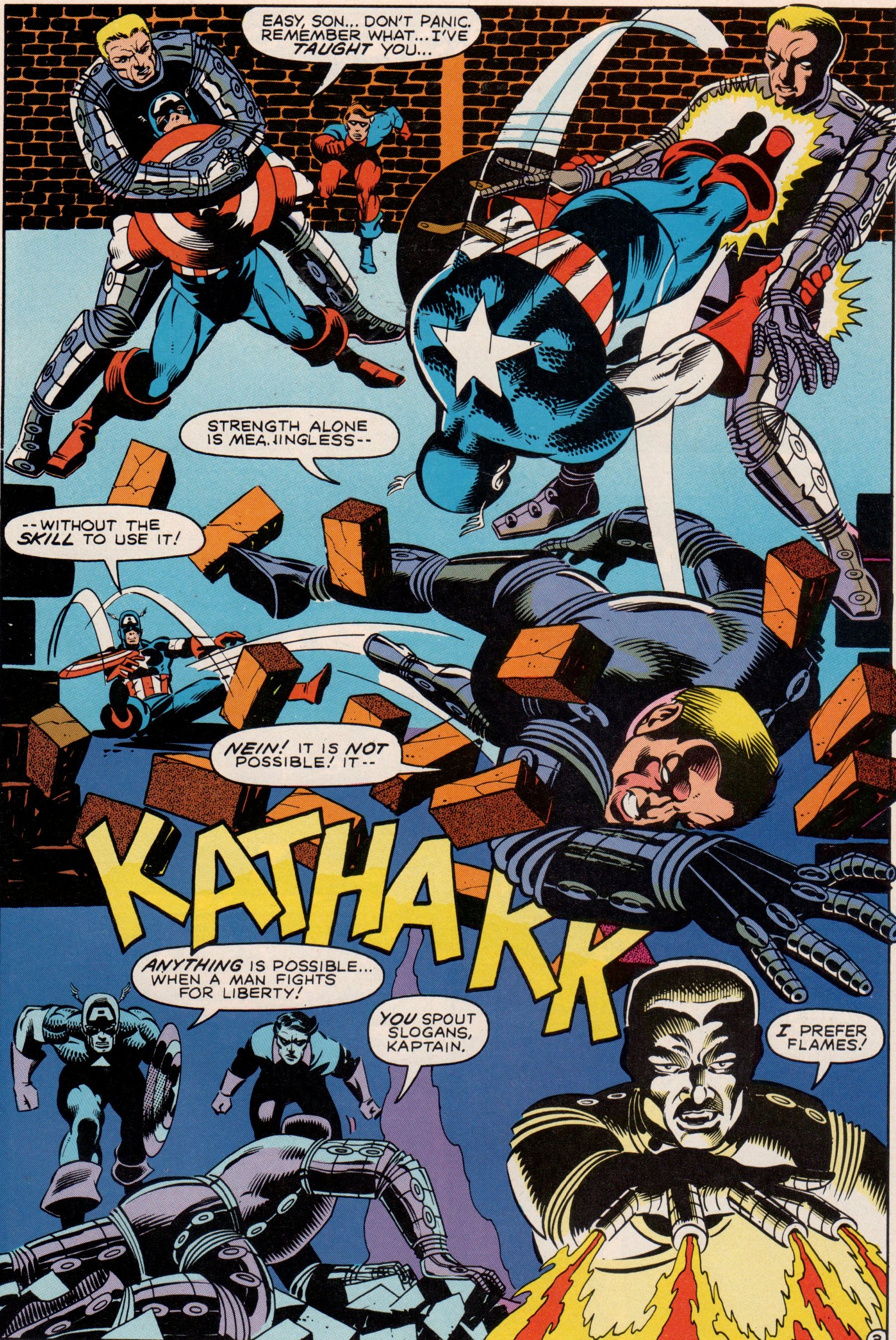
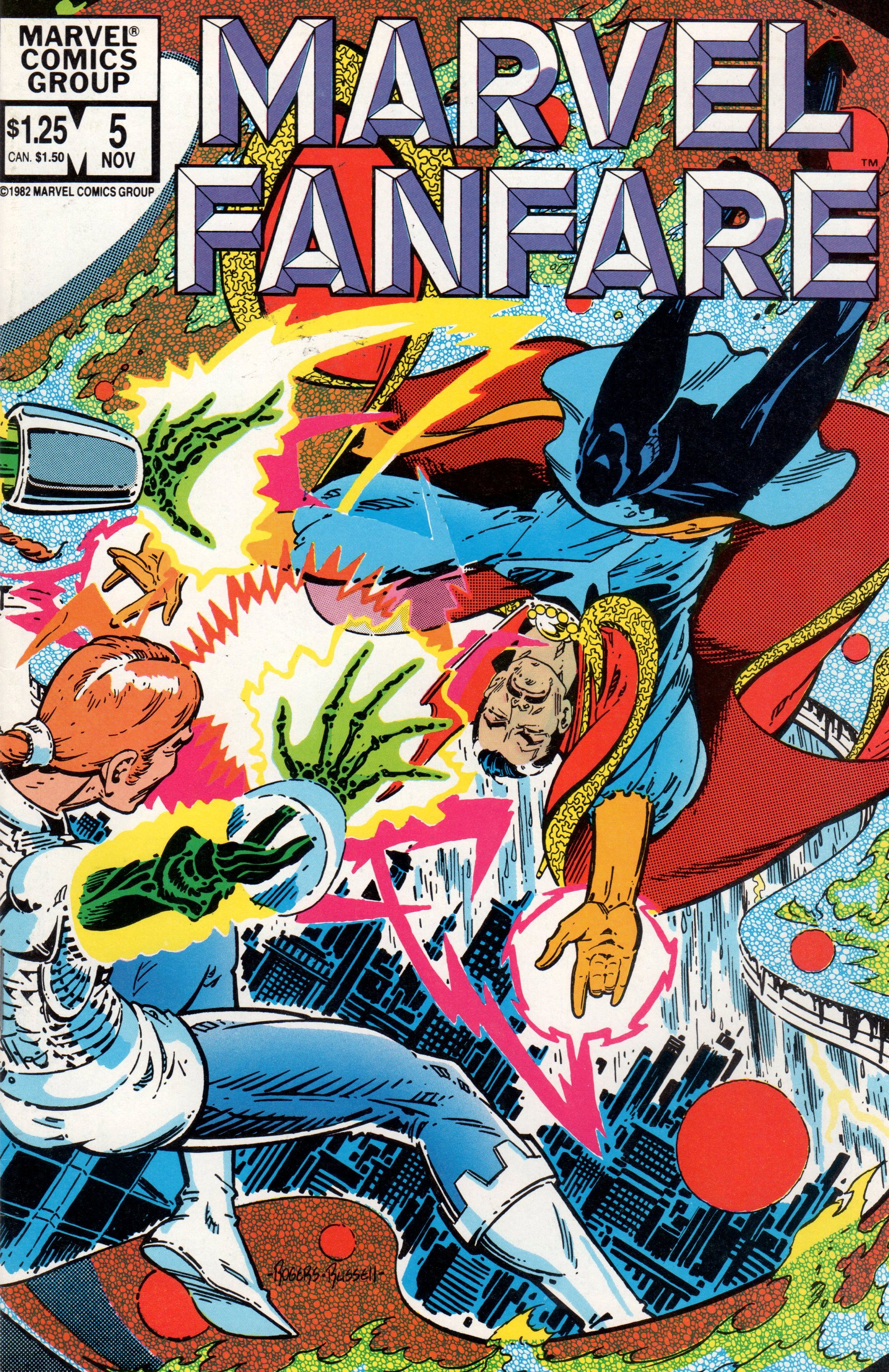
Marvel Fanfare #5, 1982 “To Steal the Sorcerer’s Soul!” and “Shall Freedom Endure…”

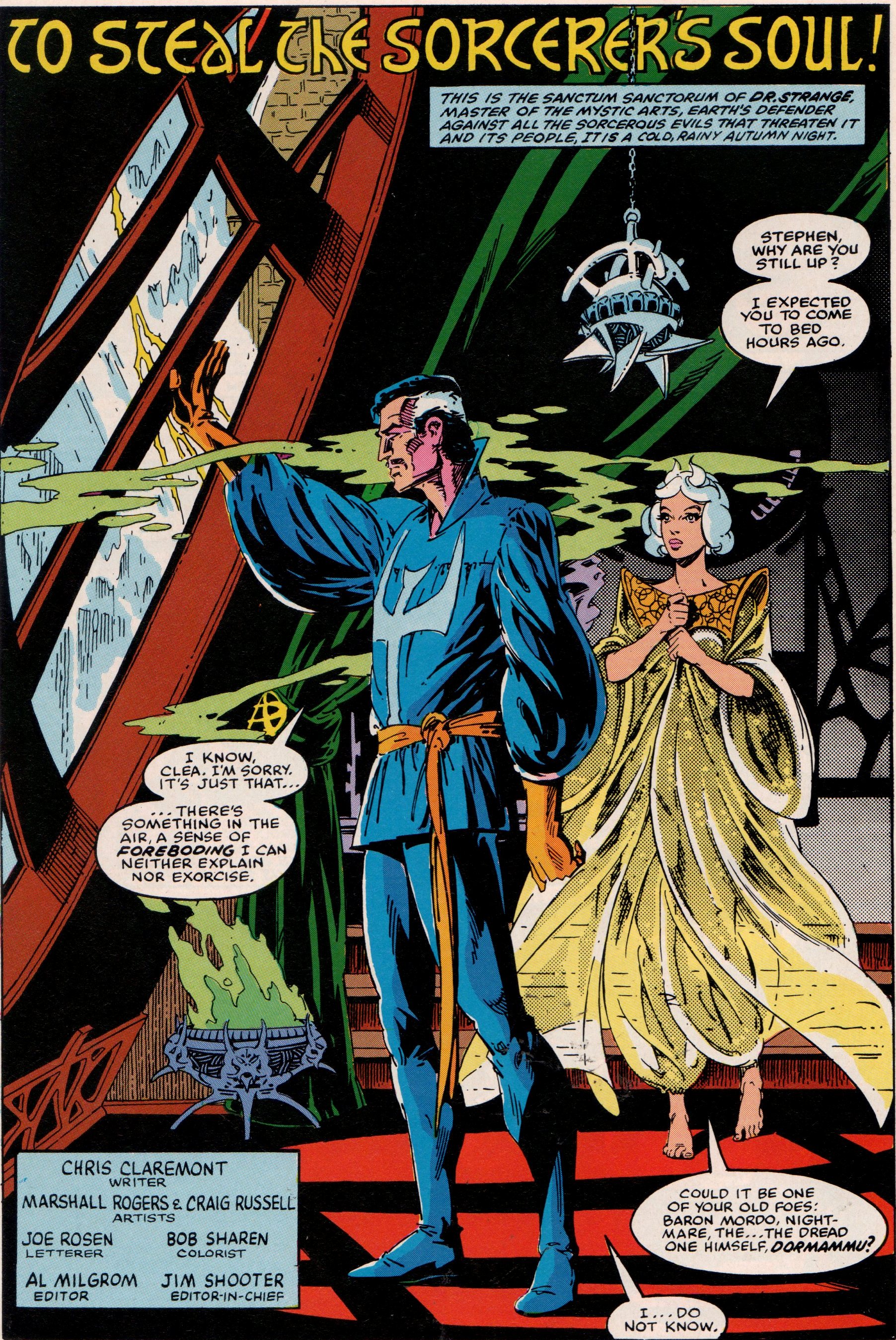
A title that gets barely any attention but really resonates with me is Marvel Fanfare. I’m typically not a big anthology book guy, but this one always intrigued me. More often than not, you got solid creators, great characters, and some awesome wrap-around covers! The stories also seemed to be quirky in some way, but not off-putting in any way. Take this issue for example. You get two stories, the first being a Dr. Strange and Clea adventure, as Nicodemus has returned, and threatens to usurp the Doc as the supreme magical being in the universe! The second tale is one that shows Cap and Bucky in a battle during WWII. Not your typical battle though, and by the end, we get to see Cap in a Nazi uniform beating on a Nazi wearing his costume!

The cover is one that is fascinating, and we have Marshall Rogers and P. Craig Russell to thank for that! Both men have worked on the character of Dr. Strange before, and this is another feather in their caps! The story about Dr. Strange features Chris Claremont (writer), Rogers and Russell on art (pencils and inks, respectively), Bob Sharen (colors), Joe Rosen (letters), and Al Milgrom (editor, both stories). The Captain America story has “Ramblin'” Roger McKenzie (writer), Luke McDonnell (pencils), John Beatty (inks), Glynis Wein (colors), and Diana Albers (letters). Get to the shop and grab some issues from this series, you wont be disappointed!


img330

img331

img332

img333

img334

img335

img336

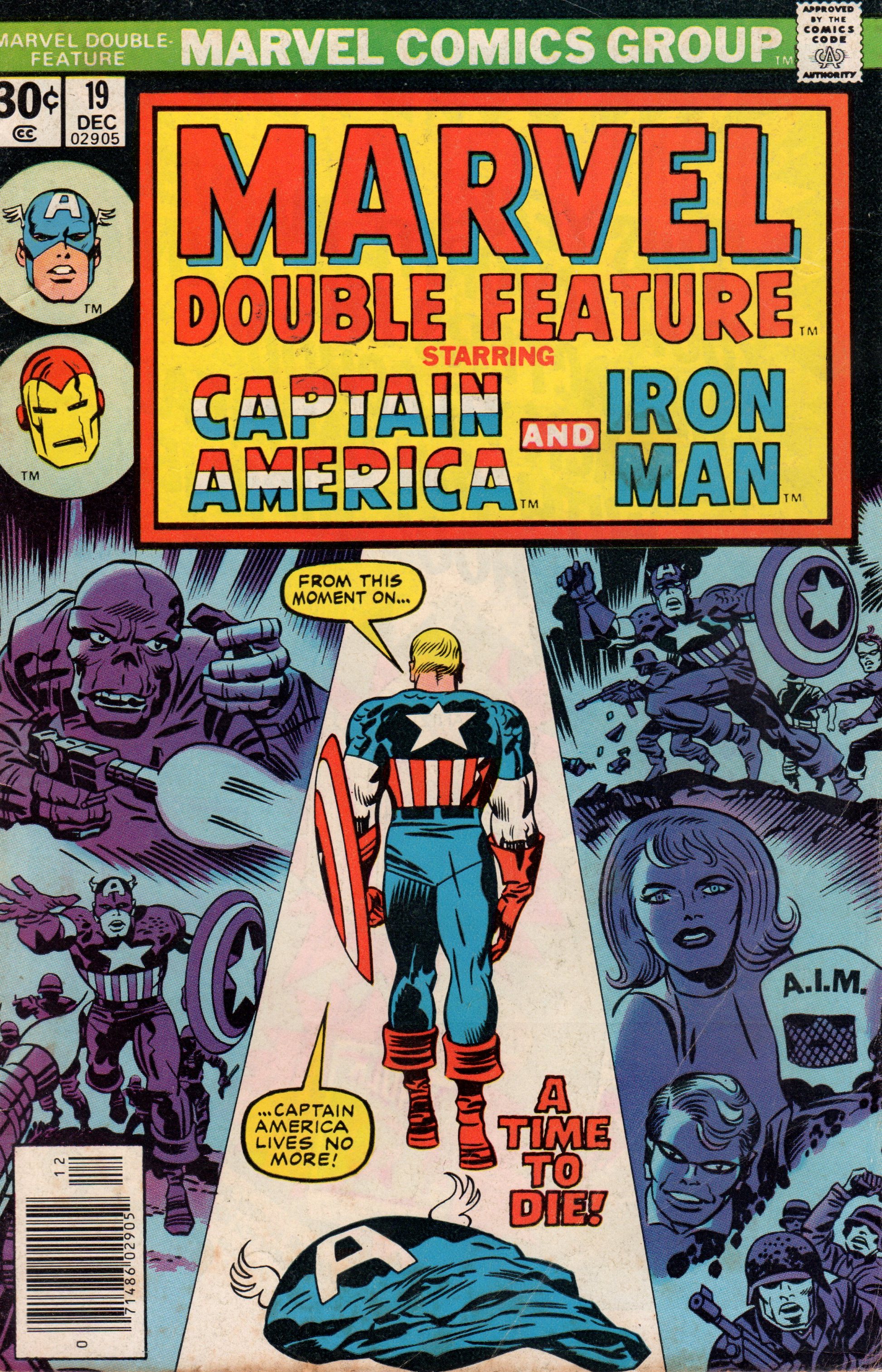
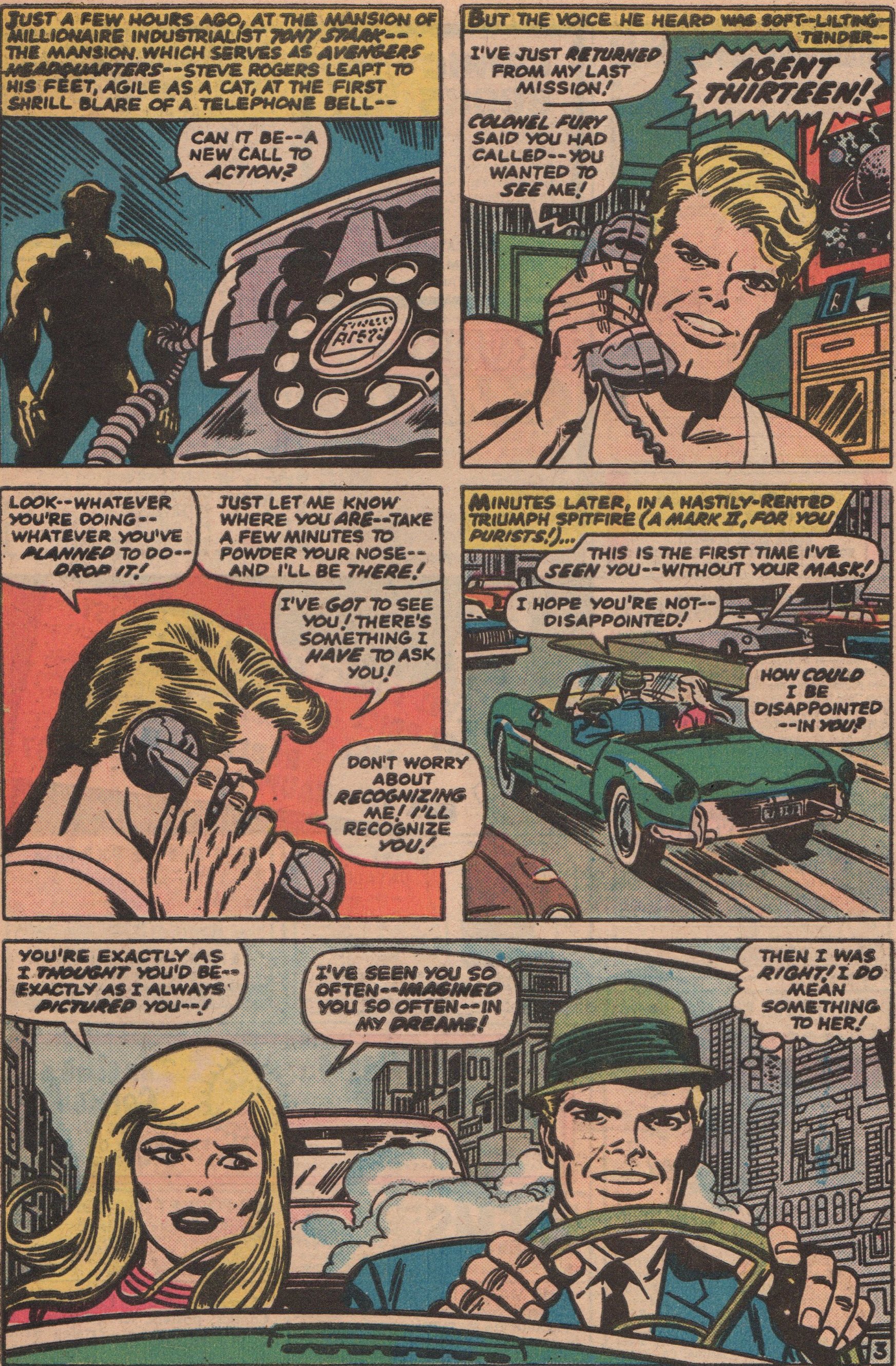
Marvel Double Feature #19, 1976 “A Time to Die–A Time to Live!”

As time marches on, back issues from the Silver Age and even the Bronze Age are creeping up in price. The scarcity of these gems is becoming a fact, and it drives the prices up. This is why I choose to go the route of reprints (the majority of the time)! Yeah, sometimes the colors are muddled with or the covers are tweaked, but I can live with that, as long as I get to read these marvelous books. In this fantastic issue, we get not only get a Captain America story, but also Iron Man! Both are classics, and have great creative teams behind them.

Speaking of creative teams, is there anyone that drew Captain America better than Jack “King” Kirby (cover and interior pencils)? Others have done fine work (Byrne, Romita, etc.), but no one seemed to really capture the essence of the character quite like the king! And who better to ink this story than “Joltin'” Joe Sinnott! Written by Stan Lee, and lettered by Artie Simek. The second story, was written by “Amiable” Archie Goodwin, the pencils by Gene “The Dean” Colan, inks by Johnny Craig (yeah, that E.C. Comics legend!), and letters once again by “Adorable” Artie Simek!


img310

img311

img312

img313

img314

img315

img316

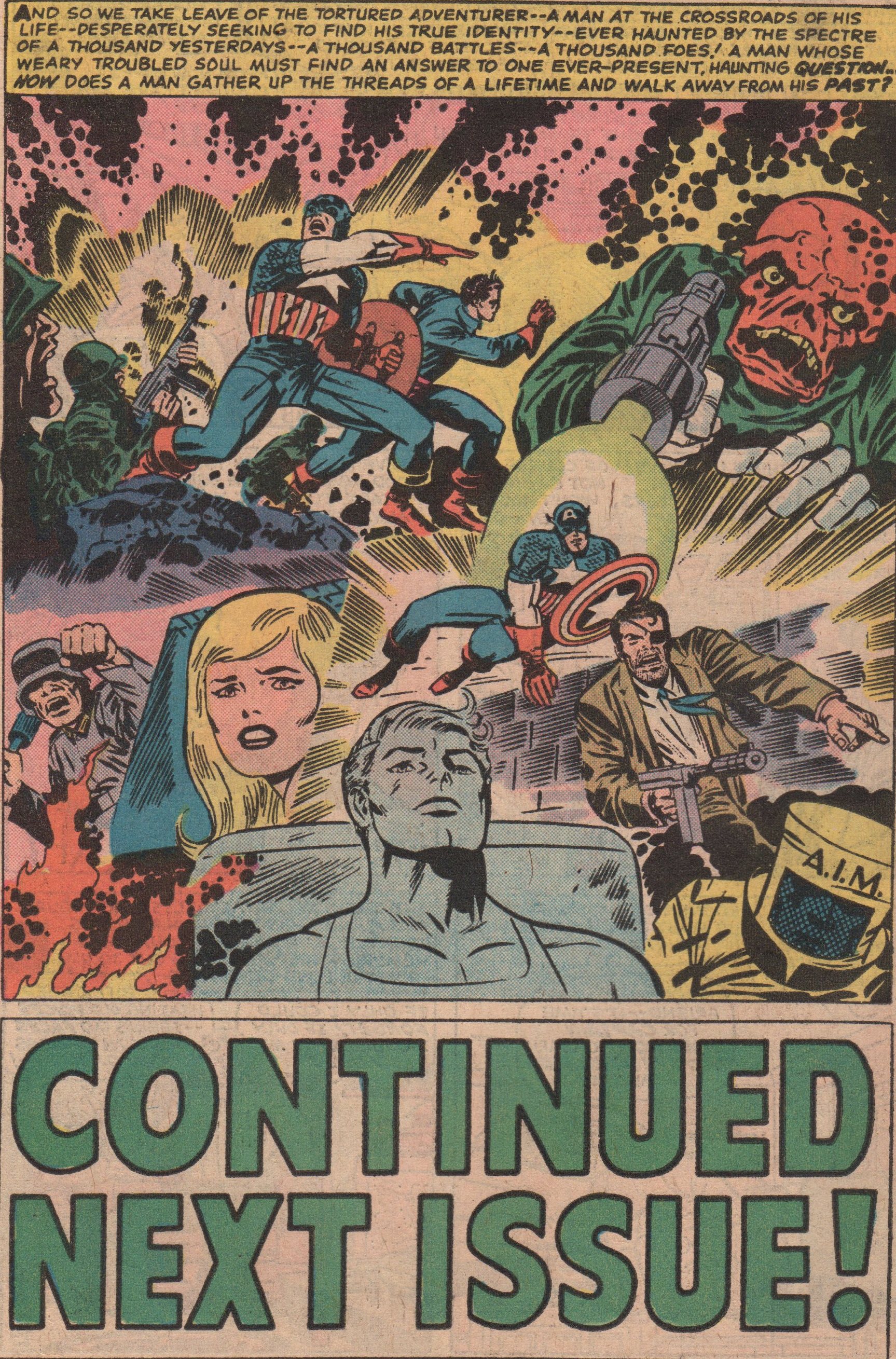
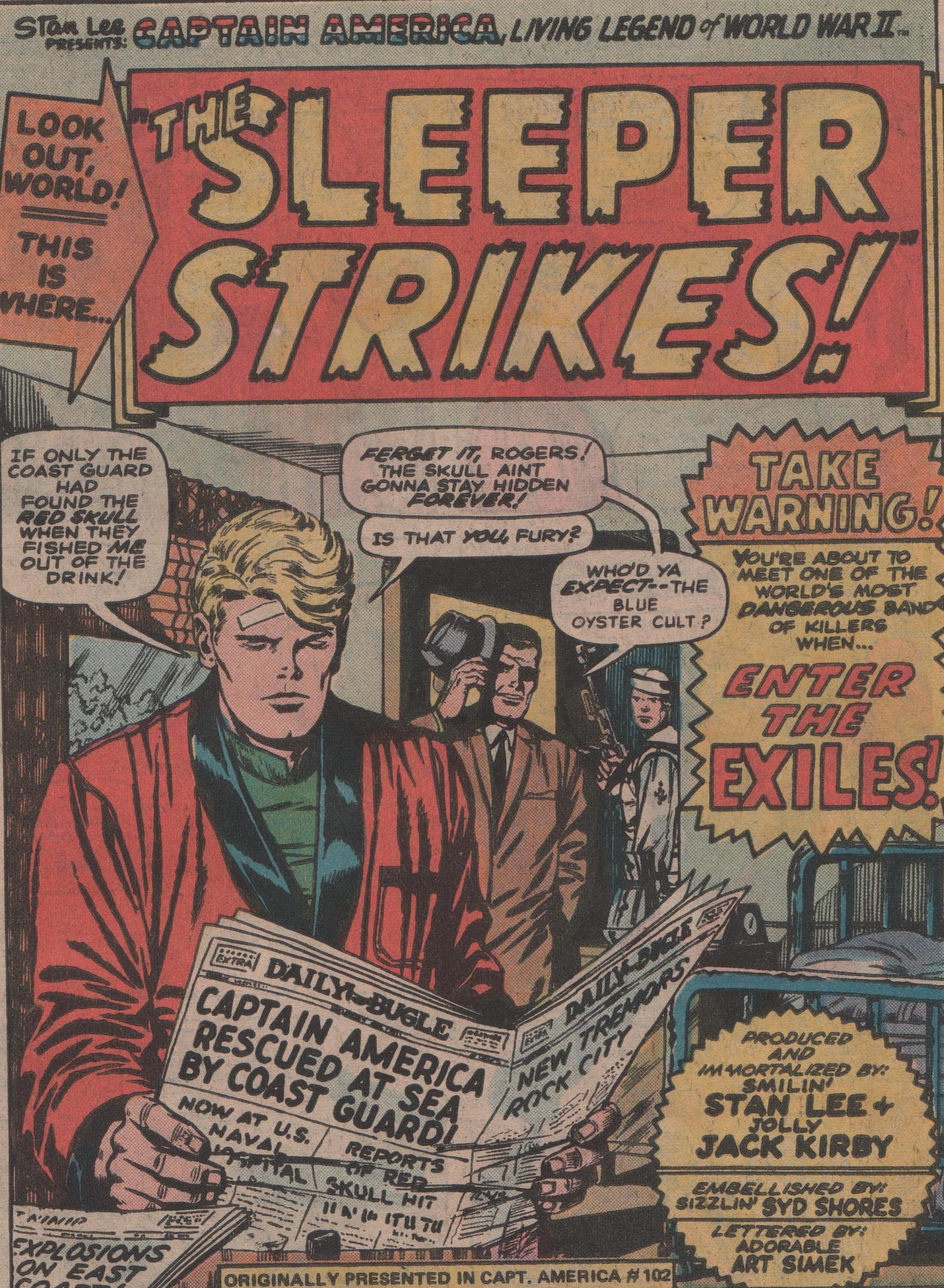
Marvel Super Action #3, 1977 “The Sleeper Strikes!”

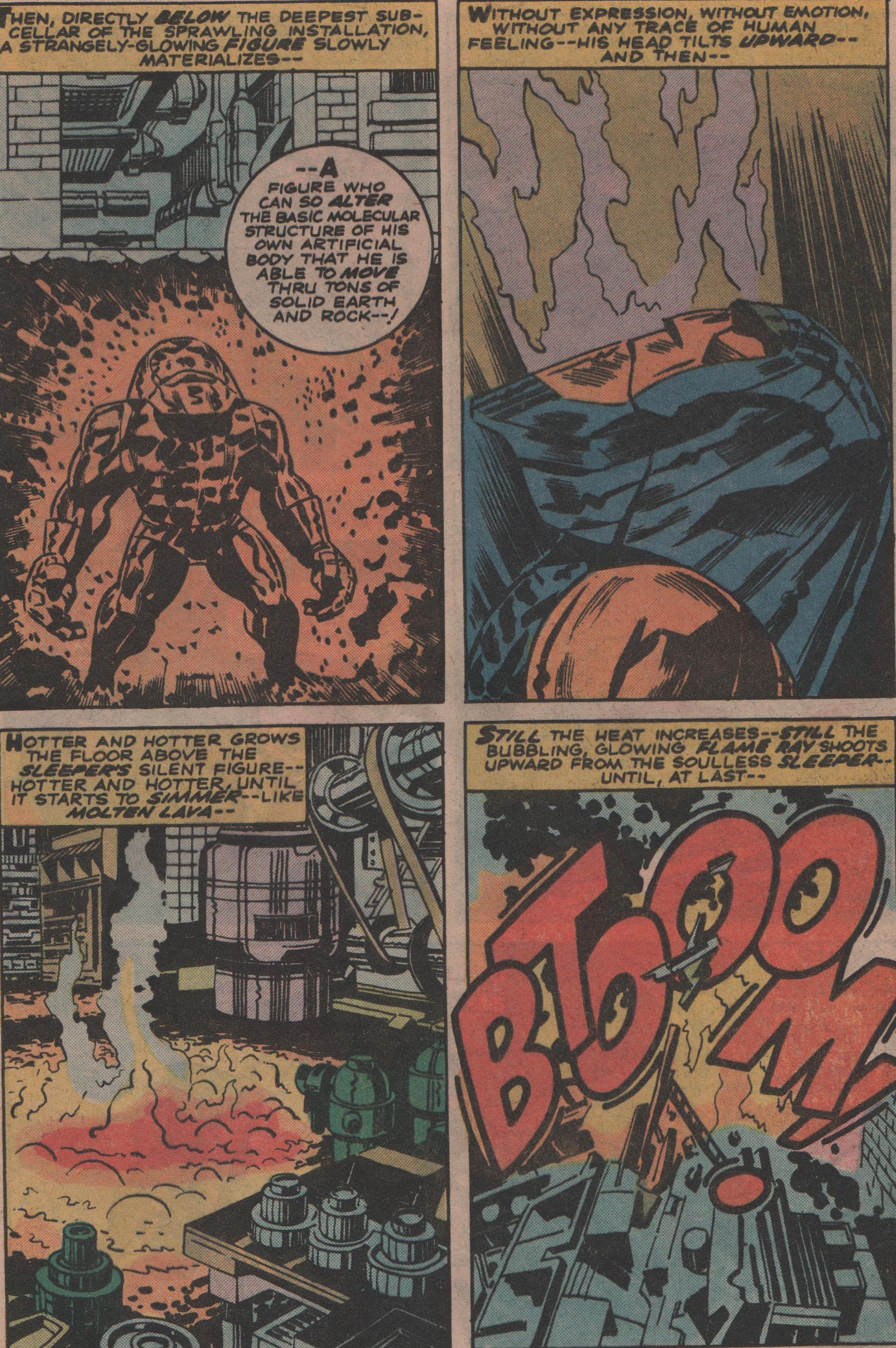
Any chance I get to grab some of Jack Kirby’s work, I don’t hesitate. I know some people are sticklers for original stuff, but I’m just fine with grabbing a fifty-cent copy of a reprint title like this one. Yeah, sometimes there are slight alterations to the covers, but typically, the interiors are the same. So, instead of trying to save up my pennies and buy a copy of Captain America #102 (1968), I’ll just look at my copy of this book (Marvel Super Action #3, 1977), and enjoy reading about the exploits of Captain America, and his fight against the Nazi weapon, the Sleeper! A guest appearance by Colonel Nick Fury, the love of Steve’s life, Sharon Carter, and the machinations of the Red Skull!

Of course, the story was scripted by Stan Lee, but the wondrous work of Jack ‘King’ Kirby is the draw. His style is perfect for a villain like the Red Skull, and the way he draws the Sleeper, is very frightening. Of course, you get the usual, brilliance with Kirby drawing Cap and the beautiful Sharon Carter (A.K.A. Agent 13), and the standard that Kirby set for that character will always be remembered! The inks are by Syd Shores, and letters by ‘Adorable’ Artie Simek.

Image

Image (2)

Image (3)

Image (4)

Image (5)

Image (6)

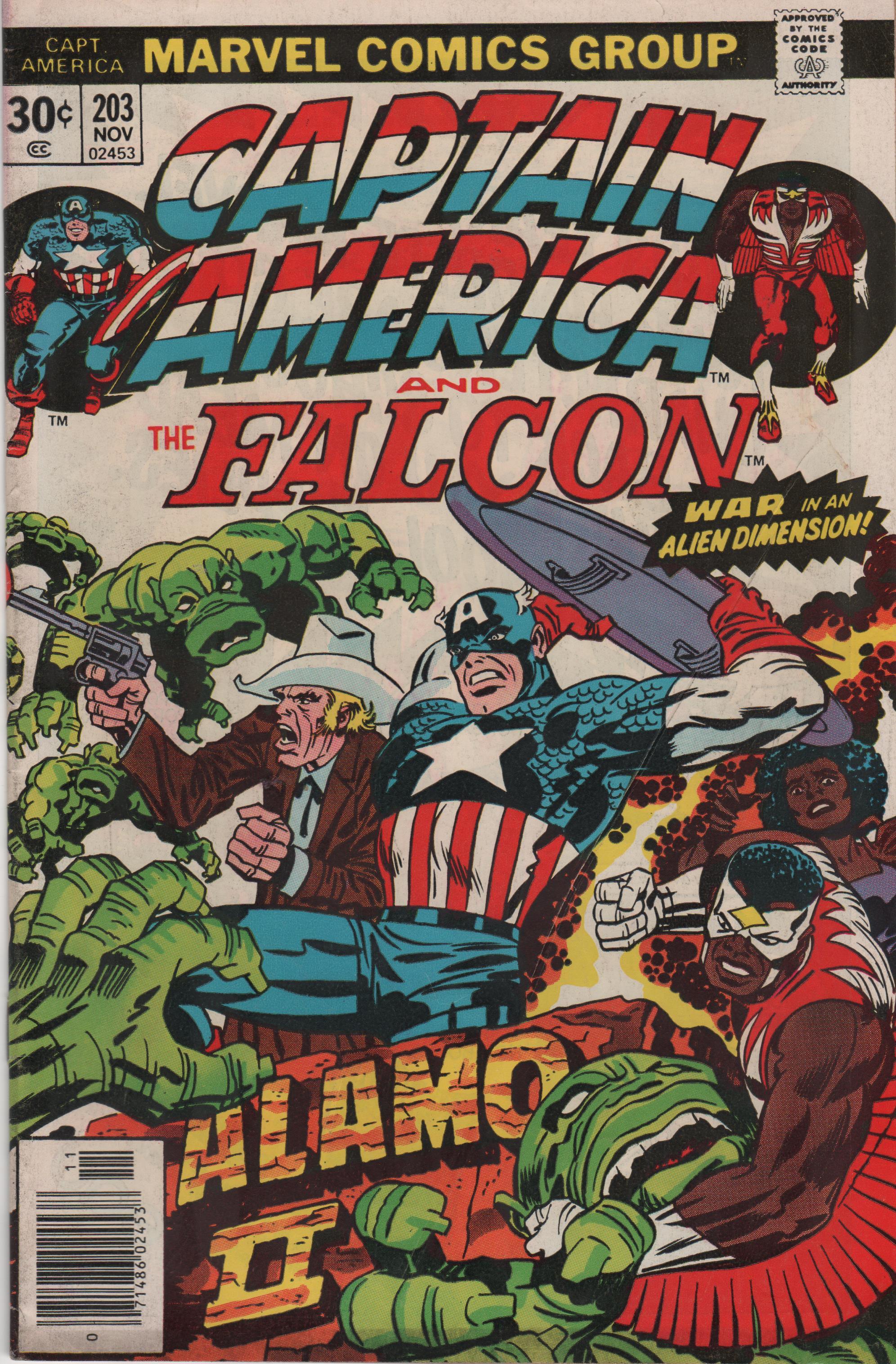
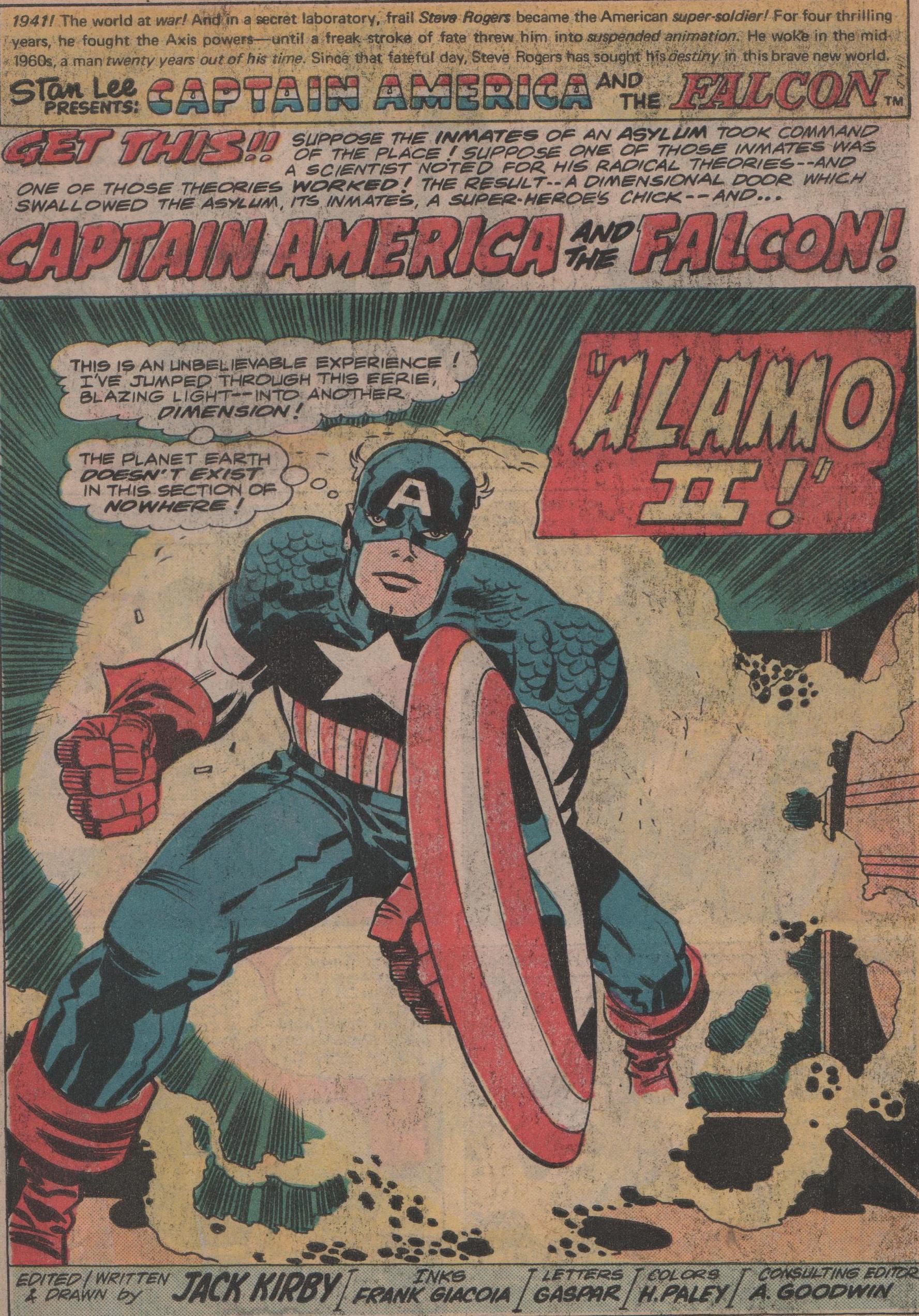
Captain America #203, 1976 “Alamo II”

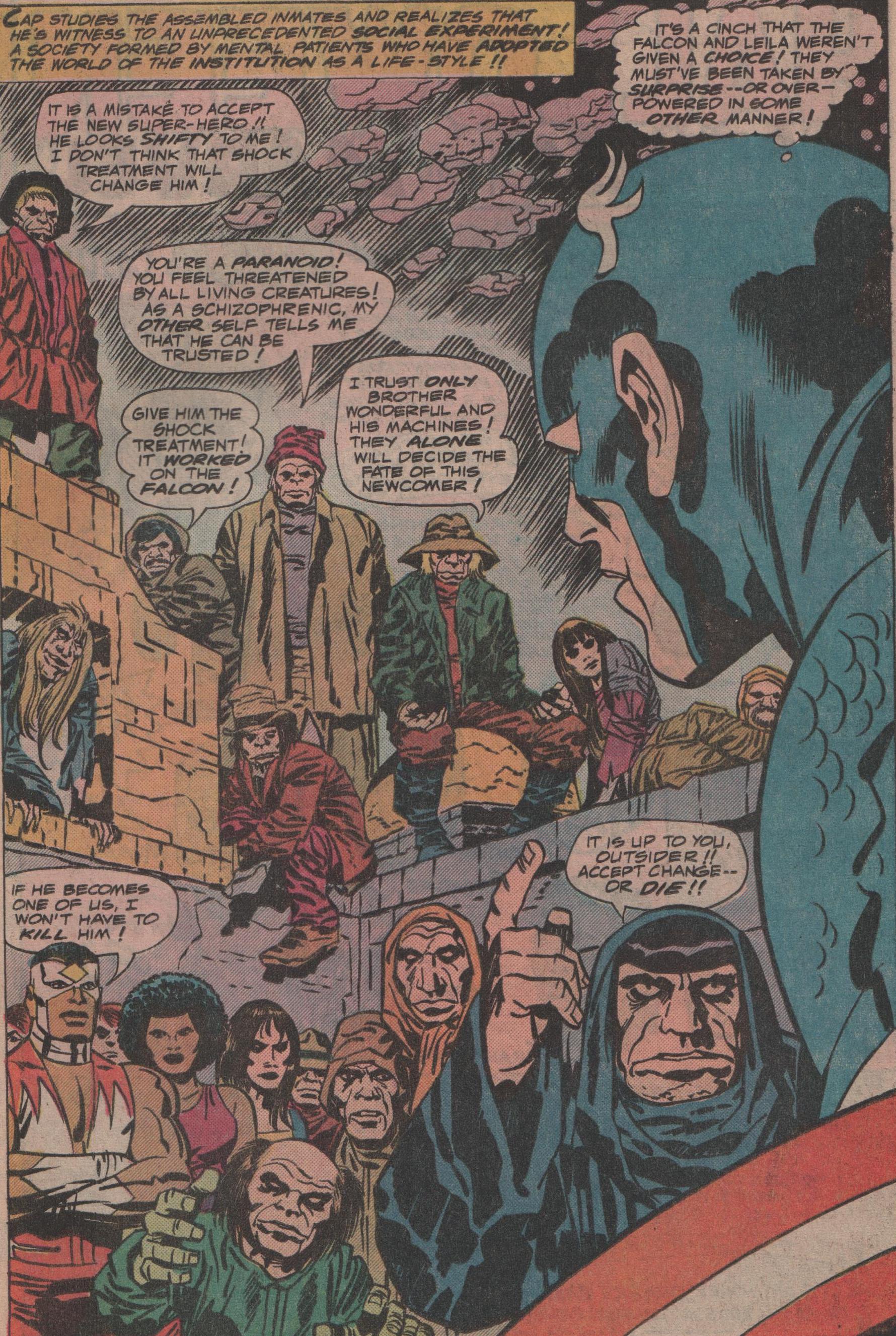
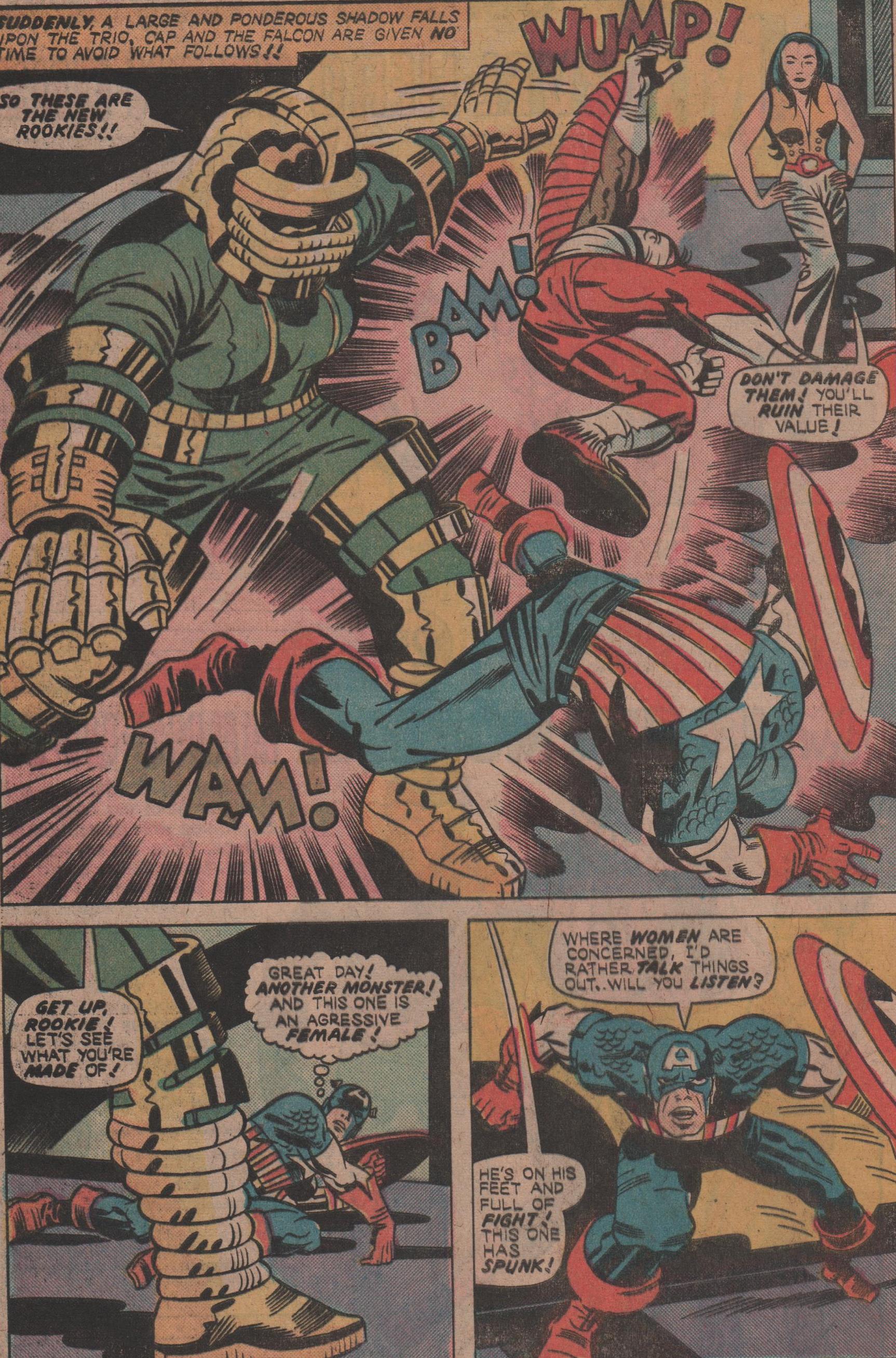
Another day, another post! And another great one from the ‘King’! No matter how many times I see an image of Captain America drawn by Jack Kirby, it still gets me pumped up about the star-spangled Avenger! It’s true, and in this adventure, Cap is searching for Falcon and Leila Taylor. He finds them, but they don’t recognize him. We then get a brawl between Cap and Falcon, and the following pages are some more Kirby magic! One splash page in particular sticks in my head, never to leave! It shows a scene of enthralled people (including Leila and Falcon), some of them sitting on a stone wall. Just the atmosphere alone is incredible!

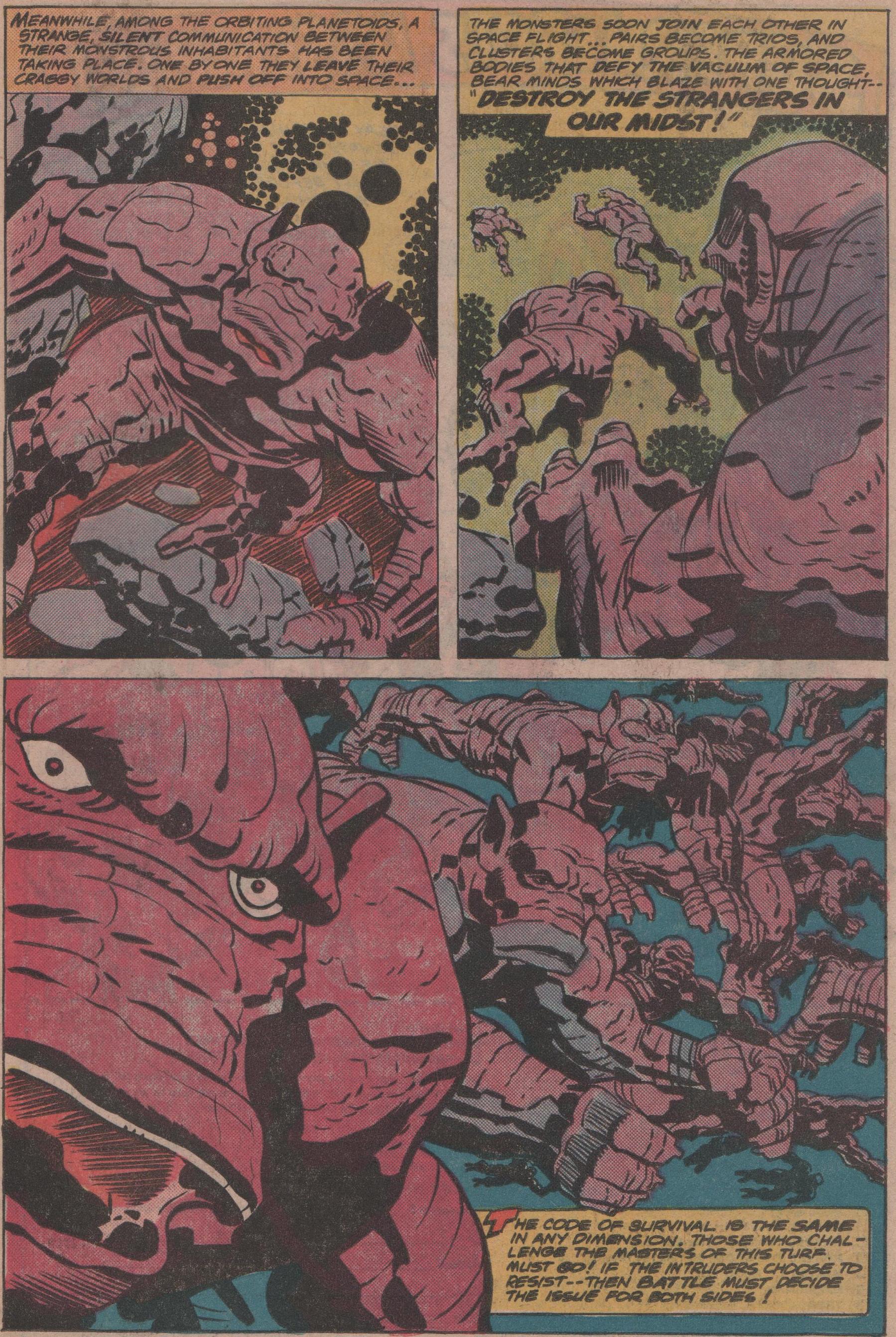
Throw in a cowboy (Texas Jack), a fire-breathing rock monster, and the machinations of the Inquisitor, top it all off with some Kirby crackle,  and you get more awesomeness from Kirby! This second coming for him on this title was quite refreshing, and it seems as though Kirby was really letting his creative freedoms flow right out on to the pages. Just look at these pages/panels, and I doubt you’ll disagree!


Image (33)

Image (32)

Image (34)

Image (35)

Image (36)

Image (37)

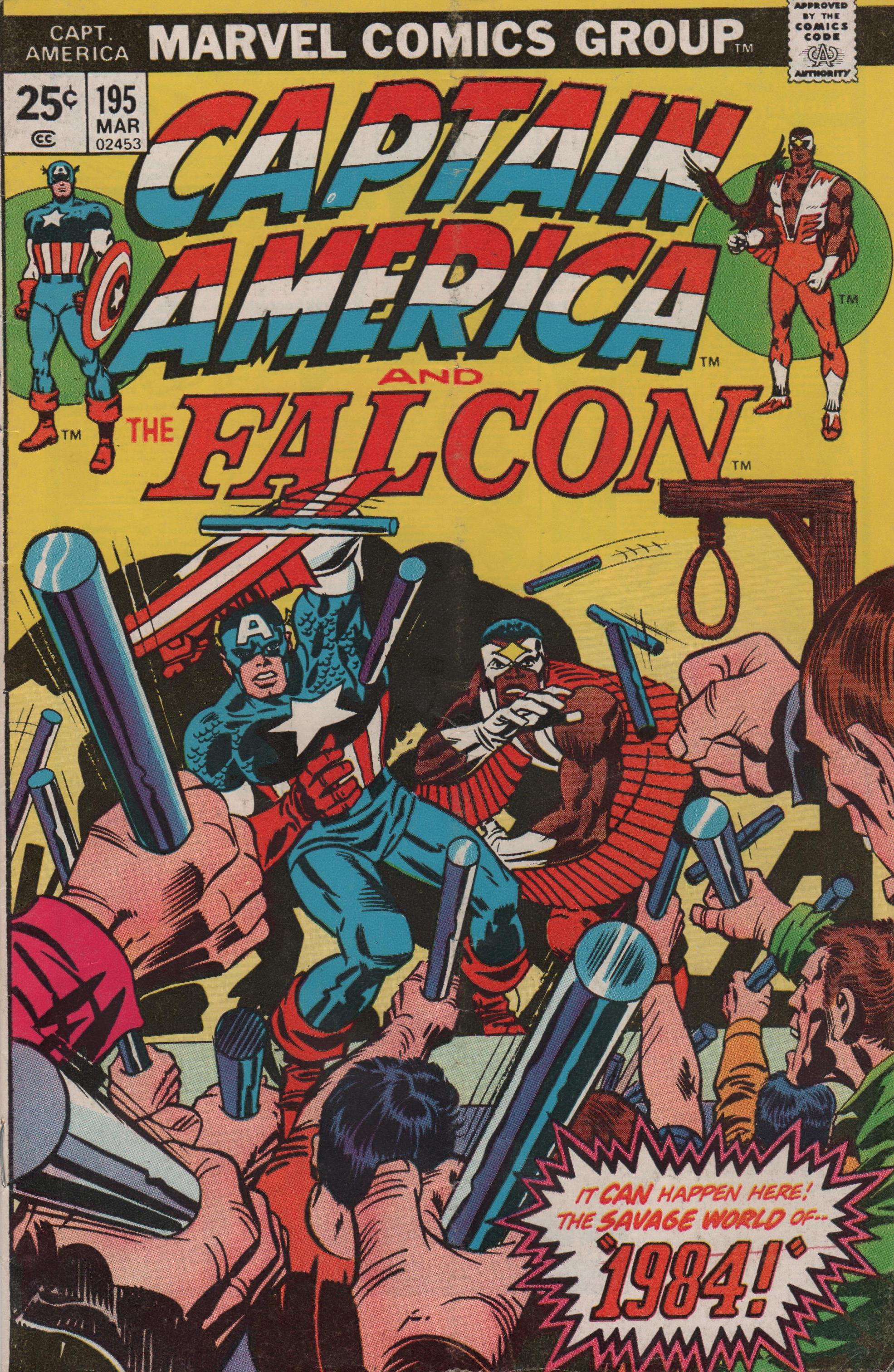
Captain America #195, 1975 “It’s 1984”

Any time I get the chance to grab some of the work of Jack ‘King’ Kirby at a discount, I do not hesitate. After his departure from DC, Kirby returned to Marvel, and did some great work. He wrote and drew Captain America, Black Panther, The Celestials, and more. I recently bought two issues of his Captain America run from this era (1975-1977), and can honestly say that this is trippy, but great work. It’s not that the story is something never written before (it’s basically a social commentary on racism), but the way Kirby writes and draws it, is absolutely endearing.

Of all the qualities I believe Kirby had as not only an artist, but as a man, this is why I love his work so much. A man who took himself from very little and used his God-given talents to become a giant of the industry (maybe only second to Will Eisner?), and through comic book art/stories gives someone like me hope that maybe someday, I can meet such apotheosis. Thank you, ‘King’ Kirby, for being an inspiration to me and scores across this planet!


Image

Image (28)

Image (29)

Image (30)

Image (31)

Comic Book Legends: An Interview with – Steve Englehart!

I think it’s safe to say, that in the 1970’s, you’d be hard-pressed to find a more diverse, determined, and dominant writer. From The Avengers, to Batman, and Captain America, Steve Englehart wrote stories that were interesting, thought-provoking, humorous, and socially significant. Among these treasures was his work on Dr. Strange.

Along with collaborator Frank Brunner (and later artwork by Gene ‘the Dean’ Colan and others), Steve spun a web involving just about every major villain the Doc had up until that point in the characters history. He also molded Clea, (apprentice/ lover of the Doc) to be more important, and not just a wallflower. The original run began in the pages of Marvel Premiere, and continued on in the Doc’s solo series. I spotlighted that run not too long ago (click here for that one), showing the mind-blowing artwork of Frank Brunner.

Alright, now that the pleasantries are done with, let’s get on with the interview!

AE49 Trial Cover.qxd

Billy: Did you read and/or draw any motivation from the Lee & Ditko work for your Doc Strange run?

Steve: Very definitely. Ditko’s Doc was legendary, and everyone thereafter tried to emulate him to some degree. Ditko’s Spidey got completely overwhelmed when Romita took it over, because Johnny was much better at the people and world that Spidey inhabited – but Ditko’s Doc remained a touchstone of “Strangeness” for everyone who followed on that strip. I had read all of it, just as I’d read all of Marvel, being a fan. I took my own approach to what I did with it, of course, but Ditko’s Doc was always the one I was fleshing out.


Billy: What was the impetus for your Dr. Strange stories? And did you approach editorial with the ideas or did they ask you (what was the process)?

Steve: Frank (Brunner) was taking over the strip full-time and did the then-unusual thing of asking for a specific writer. We knew each other only casually, socially, but he liked what I’d done on other books, so he asked that I be assigned. I had written Doc in DEFENDERS, but figured I’d need to get more mystical for his own book, so I started reading up on magick, which turned out to be interesting on its own, and my reading increasingly shaped my understanding of a sorcerer supreme. I could do this because editorial left each writer to do his job and figure out how to approach it on his own.


Billy: How tough is it juggling multiple titles on a monthly basis?

Steve: I enjoyed it. I loved all the characters, I loved working with artists…there was no real downside to it. I could do a book a week so I did four books a month, and there was always something new going on. Fun!


Billy: Did you guys use the “Marvel Method” or fully flesh out scripts together?

Steve: We did them together. Every two months we’d have dinner at his place or mine, and then talk late into the night putting the issue together. I always had concepts I wanted to explore and he had concepts he wanted to draw, and we’d make something that was more than the sum of those parts, until I, as the writer, was satisfied we had a solid issue. That was the most collaborative of any relationship I ever had with an artist.


Billy: Was killing the Ancient One something you felt fit the story (did it feel organic) or was it something you wanted to do from the get-go?

Steve: That evolved in our first late-night session. I thought Doc had been a disciple for quite a while now – and we’d inherited Shuma-Gorath and knew we had to resolve that at some point, preferably ASAP – and by the time we were done, it all came together (image below- the death of the Ancient One- Marvel Premiere #10, 1973).

Image (36)


Billy: Can you speak about the whole atmosphere/work environment at Marvel at the time (other creators you enjoyed working with, etc. in the 1970’s)?

Steve: It was just a time of complete freedom. Everyone working there was assumed to be competent to handle his own titles and was not held back in any way. If you proved yourself _unable_ to handle your titles, they became someone else’s titles, but there was no micromanaging from editorial. Thus, if you _could_ handle your titles, you could be, and were encouraged to be, as creative as possible. And this was all taking place with everyone living in the New York metro area, so pretty much everyone else in comics, at every company, was someone you knew personally. When I moved to New York, as you had to do in those days, I felt from day one like I had three hundred new friends to work and party with. Both of which we did.


Billy: When did you and Frank find out about Dr. Strange becoming an ongoing or was that known from the beginning?

Steve: The book took off with us on it, and we knew what that would lead to, but we didn’t know when. The problem, as it turned out, was that Frank couldn’t do more than a bimonthly book, so when it became an ongoing series that was monthly, he struggled and then dropped off.


Billy: You inserted many of the best villains from Dr. Strange’s rogues gallery into your stories (Shuma Gorath, Mordo, Silver Dagger, Dormammu, etc.), what was the process like for combing thru them to choose which one you’d use?

Steve: I’d always think of character concepts, then go looking for a villain to cause the story I wanted to do. With Doc, Frank and I started, and then I continued, the idea of several-issue arcs exploring a particular concept, so then it was just a question of looking back through my collection. I took every character as real within the Marvel Universe, so I knew them personally you might say, and when I wanted somebody to a certain thing, I could usually go straight to him.


Billy: I’ve read that Frank’s (Brunner) style really wasn’t conducive to the rigors of a monthly title. Is that the reason he left the book?

Steve: Yes. Even on the books he did do, you’ll occasionally see a page or two by another artist. Art was not a slap-dash thing for him.


Billy: Obviously, transitioning to a legendary artist like Gene Colan, who had previously worked on Dr. Strange, wasn’t too bad of a draw, but was it intimidating at all?

Steve: Not really, because I knew Gene’s approach intimately, from having been a fan and then having worked in the same environment. Nobody intimidated me by then; I just saw the possibilities his more photographic approach would open up, after the more designy work by Frank. I consider them equally great at what they did, and Frank’s Doc is legitimately legendary in its own right, but Gene offered new worlds to explore. (And Gene didn’t want to be involved in the stories, so I was also taking that on completely – and that was fun, too.)


Billy: Gene is my favorite artist of all time, but I never got the chance to speak with him. Could you talk about him not only from a professional stand point, but also the man himself?

Steve: As a pro, he drew what you asked him to draw, exceptionally well, without any complaint – what a writer hopes for, and usually gets from pro artists, but not always. There was nothing that stood out in the work process, which is a good thing. (The only caveat was, he wasn’t great at pacing his stories, so writers generally broke their plots down page by page for him – a minor flaw, easily corrected.) As a person, he was just a sweet guy. He knew he was good but he never acted like it, and in fact, he told me that after many years of freelancing, he never assumed that he’d get another job once he turned the current one in.


Billy: Lastly, could you speak about having Roy Thomas as an editor, and what he brought to the table?

Steve: Roy brought the gift of freedom. It was his decision to let us be as creative as possible, without his interference, and I’m forever thankful for that.

Well, that’s it for today, but before I go, I want to send out a huge thank you to Steve for doing the interview, and allowing this fan to ask one of his favorite creators of all time some questions! Below is a link to Steve’s webpage, so click and take a look!
Superstar Artists- John Byrne! Pt. 3

In this, the last installment of my John Byrne tribute, we’ll see some of his spectacular work on Captain America (with collaborator Roger Stern), his brilliant X-Men (with partner Chris Claremont) work, and a couple of nuggets from the mid-1970’s, in Marvel Team-Up! Whether it was Josef Rubinstein or Terry Austin on inks, you cannot deny the power of Byrne’s pencils. He really knew how to grab the readers eyes, and have them glued to the panels! So, get ready and strap on your seat-belt, because we’re getting cosmic and crazy with this post! Enjoy!


Image (126)

Image (125)

Image (127)

Image (128)

Image (129)

Image (130)

Image (131)

Image (132)

Image (133)

Image (134)

Image (136)

Image (137)

Image (138)

Gene Colan Tribute Part 3- Captain America!

So far we’ve seen the master, Gene Colan, and his early suspense/horror work in some of the long-lost anthology titles of the 1950’s, and his Daredevil work from the 1960’s. Now, strap yourself in for his work on the Star-Spangled Avenger, Captain America! Gene’s time on the book was very special, and when he returned in 2009 for a grand send off (color pics at the bottom), who knew this would be his last work for Marvel (and in comics, I believe). This master of the medium will be missed, but in the meantime, check out his great work on Marvel’s WWII superstar! Enjoy!

Image (31)

Image (32)

Image (33)

Image (34)

Image (36)

Image (37)

Image (35)

Gene Colan Tribute part 2- Daredevil!

Now that we’ve seen some of Gene Colan’s early horror work, lets shift gears, and check out some of his Daredevil work from his early days penciling superheroes! He was a master at telling a visual story with a character like DD, and he’ll always be my favorite Daredevil artist! Check out these incredible pages from the ‘Dean’, with some of his Daredevil work originally presented in 1967 (my copies are Marvel Adventure #3, 4, & 6, 1976)! An adventure with Ka-Zar, the wacky Leap-Frog, and a team up with Spider-Man, because you need a partner when you’re facing villains as nefarious as…The Masked Marauder and Stilt-Man? Enjoy!

Image (19)

Image (20)

Image (21)

Image (22)

Image (23)

Image (24)

Image (25)

Image (26)

Image (27)


Gene Colan Tribute- part 1!

To finish off the month of March, I let my favorite artist for last! Gene ‘The Dean’ Colan, has always been my favorite, and always will be. His style just jumps off of the pages to me, and speaks to me like no other. Over the years, he was an artist who could draw any genre, but he certainly excelled at the macabre! Just his Tomb of Dracula (with long time partner, Marv Wolfman) alone could be enough to push him into the hall of fame, but when you look at his entire body of work (Strange Tales, Daredevil, Captain America), you’ll be astonished! Let’s dispense with the verbiage, and get right down to the work of the master himself, Gene Colan! Here is some early work in the title, Strange Tales in 1952!

Image (131)

Image (132)

Image (133)

Image (134)